
Tumors evolve within complex tissue ecosystems composed of stromal cells, immune populations, epithelial cells, vasculature, and nerves. The Gomes Laboratory studies how aging reshapes the tumor microenvironment and metastatic niches to regulate tumor progression, immune function, and therapeutic response. Aging profoundly alters inflammatory signaling, extracellular matrix organization, vascular function, immune surveillance, and tissue homeostasis. We investigate how these age-associated changes create tumor-supportive environments within primary tumors and metastatic sites and how these environments influence cancer progression into metastatic disease and response to therapy.
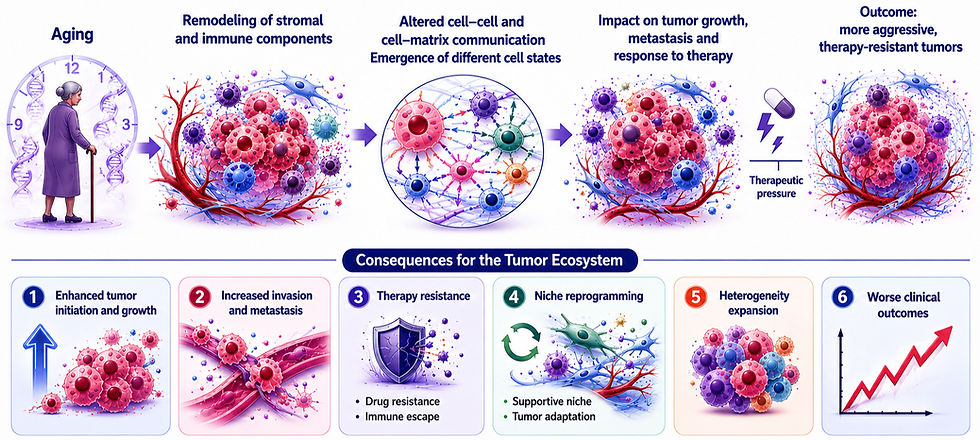
The aged macroenvironment is fundamentally different from that of younger organisms, a fact that extends to the tumor microenvironment. Aging alters stromal composition, inflammatory signaling, immune cell organization, and tissue repair programs in ways that can promote tumor growth and metastatic progression. Our laboratory uses unbiased single-cell based approaches to map how aging remodels primary tumors and metastatic niches across multiple tissues, with a particular interest in understanding how these changes influence cancer cell fate and tumor progression.
Aging Reshapes Tumor Ecosystems
We study how aging and tissue stress alter epithelial cell states within the lung, including the emergence of alveolar differentiation intermediates (ADIs). These transitional epithelial states are increasingly recognized as important regulators of tissue remodeling, inflammation, and repair following lung injury. Our laboratory has identified ADIs as major contributors to tumor microenvironment signaling in the aging lung, where they promote stem-like and therapy-resistant programs in lung cancer cells and contribute to tumor progression and poor prognosis. We are particularly interested in understanding how aging-associated inflammatory and metabolic signals drive the accumulation and persistence of ADIs and how these cells communicate with immune, stromal, and tumor populations within the lung microenvironment. By defining the mechanisms through which ADIs reshape the aging lung niche, we aim to uncover new therapeutic opportunities to target tumor-promoting epithelial remodeling in lung cancer.
Alveolar Differentiation Intermediates and Tissue Remodeling
Our laboratory investigates how aging reshapes immune organization within tumors and metastatic sites. We study how aging influences T cell activation, exhaustion, lineage plasticity, and metabolic fitness within the tumor microenvironment and systemically. We have a special interest in understanding how aging-driven metabolic alterations reshape immune cell function and contribute to dysfunctional anti-tumor immunity. We are also interested in understanding how B cells and tertiary immune structures contribute to tumor-promoting or tumor-restraining immune responses in aging tissues. A major area of interest is the understanding how these aging-associated immune and metabolic changes influence the efficacy of cellular immunotherapies, including tumor-infiltrating lymphocyte (TIL) and CAR-T cell therapies. By defining mechanisms that limit effective immune responses in aging tissues, we aim to identify strategies to improve anti-tumor immunity and enhance the efficacy of immunotherapies in older cancer patients.
T Cells, B Cells, and Immune Organization
Tumors develop within highly innervated tissues and actively interact with neural signaling pathways. The Gomes Laboratory investigates how aging reshapes tissue innervation and neuro-immune communication within the tumor microenvironment and metastatic niches. Our work aims to understand how nerve-derived signals regulate tumor progression, metastatic fitness, immune remodeling, and therapeutic response in aging tissues. We are particularly interested in how aging-associated changes alter neuro-tumor interactions and how neurotransmitters, neurotrophic factors, and axon-associated signaling pathways influence tumor cell fate and fitness. In addition, we investigate the bidirectional communication between nerves, immune cells, stromal populations, and tumor cells within aging tissues. We have a special interest in understanding how aging-associated inflammatory and metabolic changes influence neuro-tumor interactions and how neural signaling contributes to immune dysfunction, therapy resistance, and metastatic relapse.
Innervation and Neuro-Tumor Communication
How does aging reshape different metastatic niches to regulate organotropism?
Does aging synergize with other host factors such as diet and stress to fine-tune tissue fitness landscapes?
How do ADIs contribute to tumor-supportive tissue remodeling?
Questions We Are Interested In:
How does aging alter T cell and B cell function within tumors?
How do neural signals regulate tumor progression and metastasis?
Can aged tumor microenvironments be therapeutically reprogrammed?

